
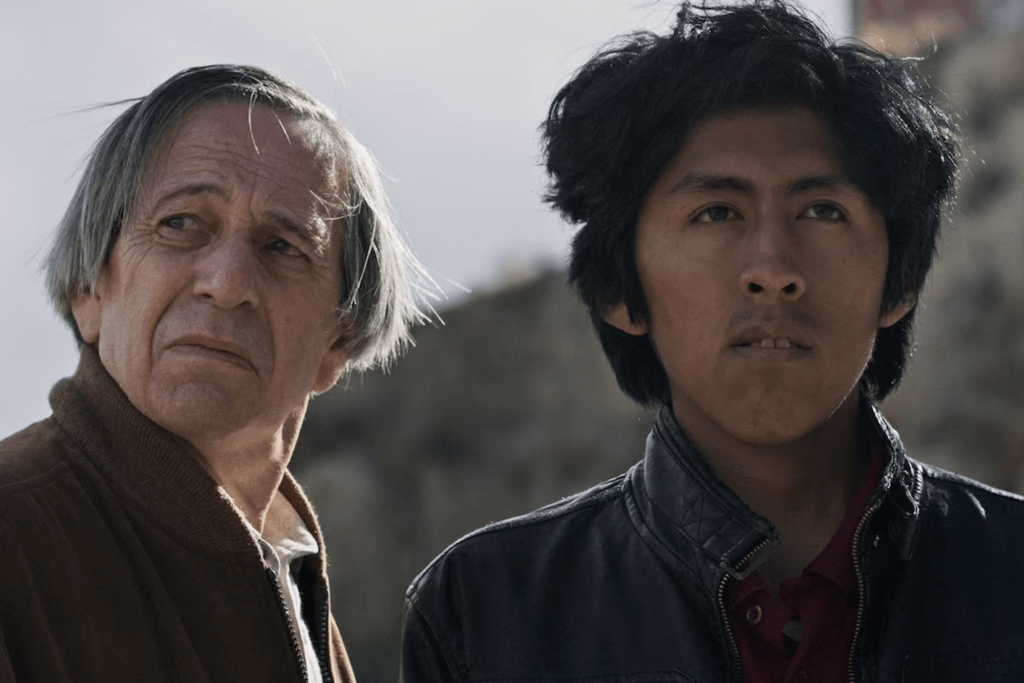
- Por EFE, El Mostrador Cultura
“El ladrón de perros”, de Vinko Tomičić, obtuvo una Mención Especial en la Competencia Latinoamericana de Largometrajes del evento transandino.
Vinko Tomičić’s “The Dog Thief” received a Special Mention in the Latin American Feature Film Competition at the trans-Andean event.
La historia de un joven limpiabotas que busca ser reconocido, pese a la paradoja de que quienes se dedican a ese oficio en Bolivia suelen esconder su identidad vistiendo un gorro pasamontañas, se narra en ‘El ladrón de perros’, el filme que ganó el fin de semana un reconocimiento en el festival de cine de Mar del Plata y representará al país andino en los premios Goya y también en los Forqué.
La película obtuvo una Mención Especial en la Competencia Latinoamericana de Largometrajes del evento transandino. Coproducida con Chile, México, Ecuador, Francia e Italia, fue escrita y dirigida por el chileno Vinko Tomičić a partir de sus recuerdos de infancia de un vecino suyo “que trabajaba como lustracalzados” en su natal Coquimbo, comentó el cineasta a EFE.
“A mí me interesan mucho los personajes que están dispuestos a hacer alguna locura por intentar mejorar la condición adversa en la que se encuentran”, señaló.
The story of a young shoeshine boy who seeks recognition, despite the paradox that those who work in this profession in Bolivia often hide their identity by wearing a balaclava, is told in ‘El ladrón de perros’, the film that won recognition at the Mar del Plata film festival over the weekend and will represent the Andean country at the Goya and Forqué awards.
The film received a Special Mention in the Latin American Feature Film Competition at the trans-Andean event. Co-produced with Chile, Mexico, Ecuador, France and Italy, it was written and directed by Chilean Vinko Tomičić based on his childhood memories of a neighbor of his “who worked as a shoe shiner” in his native Coquimbo, the filmmaker told EFE.
“I am very interested in characters who are willing to do something crazy to try to improve the adverse conditions they find themselves in,” he said.
Estrenada este año en Tribeca, la cinta se desarrolla en La Paz y cuenta la historia de Martín, un huérfano que trabaja como ‘lustra’, como se llama a los limpiabotas en Bolivia, y que un día decide robar el perro de su mejor cliente, un sastre solitario al que empieza a ver como su padre.
Según el cineasta, la película narra la lucha de Martín “por intentar ser reconocido”, aunque paradójicamente esconde su identidad detrás del pasamontañas que llevan los ‘lustras’ para evitar ser estigmatizados.
“Hay una contradicción muy fuerte entre su deseo y su vestir. Quiere ser reconocido por una sociedad, en el colegio, busca una aceptación cuando, a la vez, él mismo se esconde detrás de una máscara”, apuntó.
De padre chileno y madre boliviana, Tomičić confesó que inicialmente pensó en rodar el filme en Coquimbo, pero cambió de parecer tras visitar La Paz en 2015 para dar un taller de cine a los jóvenes del Hormigón Armado, un proyecto social que trabaja con los ‘lustras’.
“Hice talleres de cine para los chicos y luego de convivir con ellos y de conocerlos, me di cuenta de que mi guión, esta ficción que yo estaba escribiendo, era una historia más de las tantas que tenían estos chicos, que incluso eran mucho más fuertes”, explicó.
Así inició un proceso que tomó ocho años “desde la gestación de la idea hasta el día del estreno”, incluidos de por medio “muchos golpes que no nos permitieron filmar en su momento”, como el suspenso por la pandemia de la covid-19.
Con todo, Tomičić consideró que ese alargue “trajo cosas positivas, como llevar la película a un punto de maduración muy fuerte”.
Premiered this year at Tribeca, the film is set in La Paz and tells the story of Martín, an orphan who works as a shoe shiner, as shoeshiners are called in Bolivia, and who one day decides to steal the dog of his best client, a lonely tailor whom he begins to see as his father.
According to the filmmaker, the film tells of Martín’s struggle «to try to be recognized,» although paradoxically he hides his identity behind the balaclava that shoe shiners wear to avoid being stigmatized.
«There is a very strong contradiction between his desire and his clothing. He wants to be recognized by society, at school, he seeks acceptance when, at the same time, he himself hides behind a mask,» he said.
Born to a Chilean father and a Bolivian mother, Tomičić confessed that he initially thought of filming the movie in Coquimbo, but changed his mind after visiting La Paz in 2015 to give a film workshop to the youth of Hormigón Armado, a social project that works with the ‘lustras’.
“I did film workshops for the kids and after spending time with them and getting to know them, I realized that my script, this fiction that I was writing, was one more of the many stories that these kids had, that they were even much stronger,” he explained.
Thus began a process that took eight years “from the gestation of the idea to the day of the premiere,” including “many blows that did not allow us to film at the time,” such as the suspense due to the covid-19 pandemic.
However, Tomičić considered that this extension “brought positive things, such as bringing the film to a very strong point of maturity.”
Orgullo ‘lustra’
El proceso para elegir a los protagonistas también fue largo, hasta que en una de las últimas etapas apareció Franklin Aro Huasco, un ‘lustra’ que “sorprendió” a Tomičić y al equipo de producción “con su interpretación, con el poder de su mirada y con su sensibilidad”.
“Uno pasa mucho tiempo escribiendo un personaje, construyendo un universo a través de la palabra, del guión. Entonces cuando de pronto ocurre el momento en que uno ve ese rostro que creó en su mente y lo ve frente a uno, ahí es cuando uno hace el ‘match’ (la conexión) y con Franklin fue así”, comentó el cineasta.
Aro dijo a EFE que trabajó como limpiabotas desde sus 10 años, filmó la película cuando tenía 16, terminó el colegio en 2022 y actualmente, a sus 20 años, se declara “muy feliz de representar a Bolivia” y que le digan que es un “orgullo” para el país.
El joven destacó la experiencia ganada, el haber perdido miedo a expresarse, además de sentirse “orgulloso de ser lustracalzados”.
Aro ganó una mención honorífica como actor revelación en el festival de Guadalajara y fue reconocido como mejor actor en el de Santiago y en la competencia internacional de Antalya, Turquía, donde Tomičić fue elegido mejor director.
Tomičić señaló que “es un honor” representar a Bolivia en los premios Goya y que “sería maravilloso” quedar entre las cinco finalistas a Mejor Película Iberoamericana.
También destacó que fue una sorpresa estar nominados a Mejor Película Latinoamericana en los premios Forqué, considerados una antesala de los Goya, ya que el filme recién se estrenará en España en marzo próximo.
Aunque, aseguró, el “mayor premio” es la “conexión” lograda con el público “alrededor del mundo”.
Pride of ‘lustra’
The process to choose the protagonists was also long, until in one of the last stages Franklin Aro Huasco appeared, a ‘lustra’ who “surprised” Tomičić and the production team “with his interpretation, with the power of his gaze and with his sensitivity”.
“One spends a lot of time writing a character, building a universe through the word, the script. Then when suddenly the moment occurs when one sees that face that one created in one’s mind and sees it in front of one, that is when one makes the ‘match’ (the connection) and with Franklin it was like that”, commented the filmmaker.
Aro told EFE that he worked as a shoeshine boy since he was 10 years old, filmed the movie when he was 16, finished school in 2022 and currently, at 20 years old, he declares himself “very happy to represent Bolivia” and to be told that he is a “pride” for the country.
The young man highlighted the experience he has gained, having lost his fear of expressing himself, as well as feeling “proud of being a shoe shiner.”
Aro won an honorable mention as a new actor at the Guadalajara festival and was recognized as best actor at the Santiago festival and at the international competition in Antalya, Turkey, where Tomičić was chosen as best director.
Tomičić said that “it is an honor” to represent Bolivia at the Goya awards and that “it would be wonderful” to be among the five finalists for Best Ibero-American Film.
He also stressed that it was a surprise to be nominated for Best Latin American Film at the Forqué awards, considered a prelude to the Goyas, since the film will only be released in Spain next March.
Although, he said, the “greatest prize” is the “connection” achieved with the public “around the world.”
| Si tienes una historia que quieras difundir, escríbenos. If you have a story you want to spread, write to us. catalina.aguilar@caleidoscopiodigital.com |
 Caleidoscopio Digital
Deja un comentario