- Por Artishockrevista.com, Alejandro Arturo Martínez.
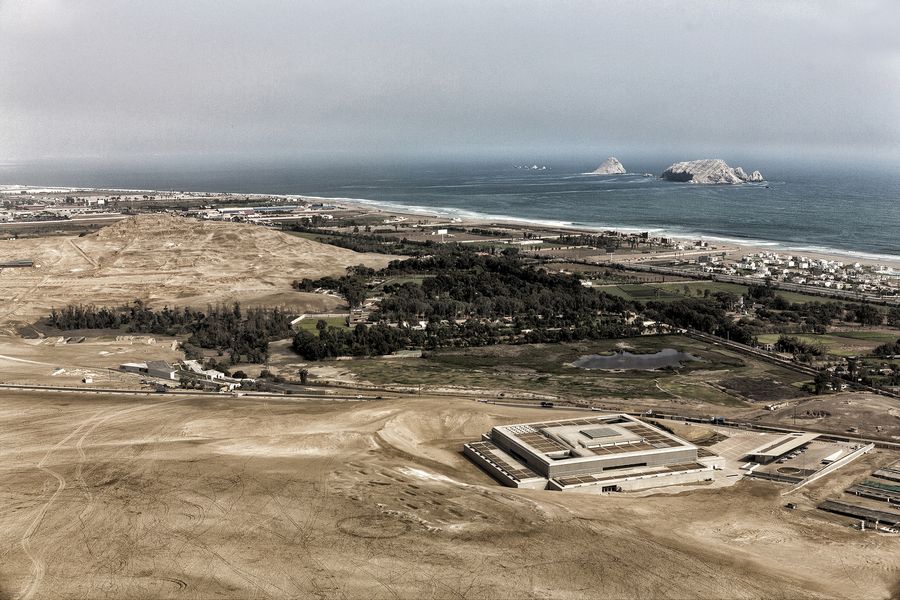
El Museo Nacional del Perú (MUNA) se eleva en el paisaje de Lurín como una estructura monumental, destinada a custodiar el vasto patrimonio cultural y arqueológico del país. No obstante, esta monumentalidad, en lugar de consolidarse como archivo viviente de la historia nacional, se despliega en un espacio casi vacío, evidenciando tensiones estructurales e institucionales que exponen las complejidades de la política cultural peruana.
Click here for translation
The National Museum of Peru (MUNA) rises in the landscape of Lurin as a monumental structure, destined to guard the vast cultural and archaeological heritage of the country. However, this monumentality, instead of consolidating itself as a living archive of national history, unfolds in an almost empty space, evidencing structural and institutional tensions that expose the complexities of Peruvian cultural policy.
Since its opening in 2021, the MUNA faces the paradox of a “spatial excess”: a building designed to house a vast heritage that, in reality, lacks permanent content, presents limited accessibility and reveals a fragmented institutionality. This emptiness is not incidental; rather, it symbolizes a dilemma about how to generate critical interpretations that make it possible to assemble past and future and to deal with the challenges of public institutionality and the failures of a state policy sustained over time.
In its constitution, the archive generates a problem of space. Those of us who work with archives constantly deal with the physical and virtual limits of storage, a reality intensified in the digital era, where the “cloud” seems to promise endless expansion, hiding the material infrastructure that sustains it. In contrast, the MUNA, built at a cost of one hundred and fifty million dollars, seeks to compensate for the lack of physical spaces for heritage in Peru, but in its current state faces the paradox of emptiness on a monumental scale.
This tension between excess space and lack of content leads one to question the very essence of the MUNA in its possibility of constituting itself as a national archive. Can an empty space function as an archive? Pierre Nora argues that archives emerge in the face of the “anguish of memory”; places of memory, he writes, emerge when it becomes clear that spontaneous memory is insufficient to sustain a shared narrative. In the case of the MUNA, the physical void not only reflects not only a material absence, but also a lack of historical narrative, a testimony of unfinished promises and an institutionalism incapable of occupying, even socially, the spaces designed to approach Peruvian history.
The void in the MUNA is, in this sense, a critical dimension that questions the way history has been narrated. Its empty monumentality does not constitute an accidental absence; rather, it functions as an “archive of the absent” that questions the foundations of the official narrative and the structures that sustain it. The lack of permanent collections and the continuous postponement of its inauguration expose silences and omissions in the narrative of national identity, revealing the difficulty of building a cohesive cultural project in a context of political instability.
The emptiness of the MUNA, in its current state, transcends the architectural to represent the limitations of politics in Peru. The high turnover of ministers and directors in the Ministry of Culture, not to mention presidents, has generated discontinuity in management, hindering the consolidation of a coherent and sustained vision. This lack of continuity and the abandonment of the founding narrative – which promised a unified national identity two hundred years after independence – are evidence of the contradictions in the attempt to build a cohesive memory.
The function of a national museum should, of course, go beyond preserving objects, to become a space that articulates the past and makes it resonate in the present. In the case of an archive, as Alejandra Celedón has written, it should also be able to articulate where we live and how we think at a moment in history. In this sense, the MUNA is an ambivalent symbol: at once an aspiration to build a national memory and a testimony to the structural and symbolic deficiencies capable of producing form.
Unlike other national museums that manage to transcend the mere conservation of objects to activate cultural reflection, the MUNA remains trapped in a white march that, instead of forming audiences, becomes a large waiting room. Thus, the future of the MUNA will depend on its ability to overcome these barriers and transform itself into a place to question, remember and reimagine history. Only in this way will it be able to fill its physical and institutional void and become a living archive of Peruvian memory.
Desde su apertura en 2021, el MUNA enfrenta la paradoja de un “exceso espacial”: un edificio pensado para albergar un vasto patrimonio que, en realidad, carece de contenido permanente, presenta accesibilidad limitada y revela una institucionalidad fragmentada. Este vacío no es incidental; más bien, simboliza un dilema sobre cómo generar interpretaciones críticas que permitan ensamblar pasado y futuro y lidiar ante los retos de la institucionalidad pública y las fallas de una política estatal sostenida en el tiempo.
En su constitución, el archivo genera un problema de espacio. Quienes trabajamos con archivos lidiamos constantemente con los límites físicos y virtuales de almacenamiento, una realidad intensificada en la era digital, donde la “nube” parece prometer una expansión sin fin, ocultando la infraestructura material que la sostiene. En contraste, el MUNA, construido a un costo de ciento cincuenta millones de dólares, busca compensar la falta de espacios físicos para el patrimonio en Perú, pero en su estado actual se enfrenta a la paradoja de la vacuidad en una escala monumental.
Esta tensión entre exceso de espacio y falta de contenido lleva a cuestionar la esencia misma del MUNA en su posibilidad de constituirse como archivo nacional. ¿Puede un espacio vacío funcionar como archivo? Pierre Nora sostiene que los archivos surgen ante la “angustia de la memoria”; los lugares de memoria, escribe, emergen cuando queda claro que la memoria espontánea es insuficiente para sostener una narrativa compartida. En el caso del MUNA, el vacío físico no solo solo da cuenta de una ausencia material, sino de una carencia de narrativa histórica, de un testimonio de promesas inconclusas y de una institucionalidad incapaz de ocupar, incluso socialmente, los espacios diseñados para aproximarse a la historia peruana.
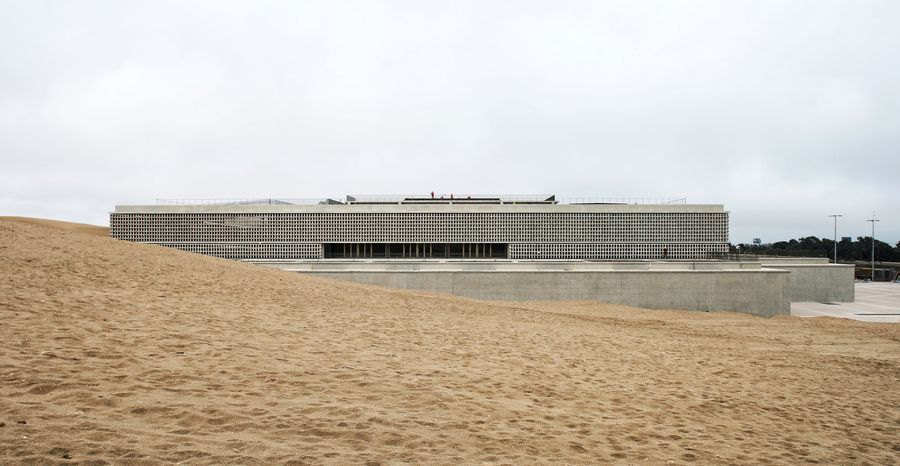

El vacío en el MUNA es, en este sentido, una dimensión crítica que cuestiona la forma en que se ha narrado la historia. Su monumentalidad vacía no constituye una ausencia accidental; más bien, funciona como un “archivo de lo ausente” que interpela las bases de la narrativa oficial y las estructuras que la sostienen. La carencia de colecciones permanentes y la postergación continua de su inauguración exponen silencios y omisiones en la narrativa de identidad nacional, revelando la dificultad de construir un proyecto cultural cohesivo en un contexto de inestabilidad política.
El vacío del MUNA, en su estado actual, trasciende lo arquitectónico para representar entonces las limitaciones de la política en el Perú. La alta rotación de ministros y directores en el Ministerio de Cultura, por no decir de presidentes, ha generado discontinuidad en la gestión, obstaculizando la consolidación de una visión coherente y sostenida. Esta falta de continuidad y el abandono de la narrativa fundacional —que prometía una identidad nacional unificada a doscientos años de la independencia— evidencian las contradicciones en el intento de construir una memoria cohesionada.
La función de un museo nacional debería, claro está, ir más allá de conservar objetos, para constituirse en un espacio que articule el pasado y lo haga resonar en el presente. En el caso de un archivo, como ha escrito Alejandra Celedón, también debe ser capaz de permitir articular el dónde vivimos y cómo pensamos en un momento de la historia. En este sentido, el MUNA supone un símbolo ambivalente: a la vez una aspiración por construir una memoria nacional y un testimonio de las carencias estructurales y simbólicas capaces de producir forma.
A diferencia de otros museos nacionales que logran trascender la mera conservación de objetos para activar la reflexión cultural, el MUNA sigue atrapado en una marcha blanca que, en vez de formar públicos, se convierte en una gran sala de espera. De este modo, el futuro del MUNA dependerá de su capacidad para superar estas barreras y transformarse en un lugar que permita cuestionar, recordar y reimaginar la historia. Solo así podrá llenar su vacío físico e institucional y convertirse en un archivo vivo de la memoria peruana.
| Si tienes una historia que quieras difundir, escríbenos. If you have a story you want to spread, write to us. catalina.aguilar@caleidoscopiodigital.com |
 Caleidoscopio Digital
Deja un comentario